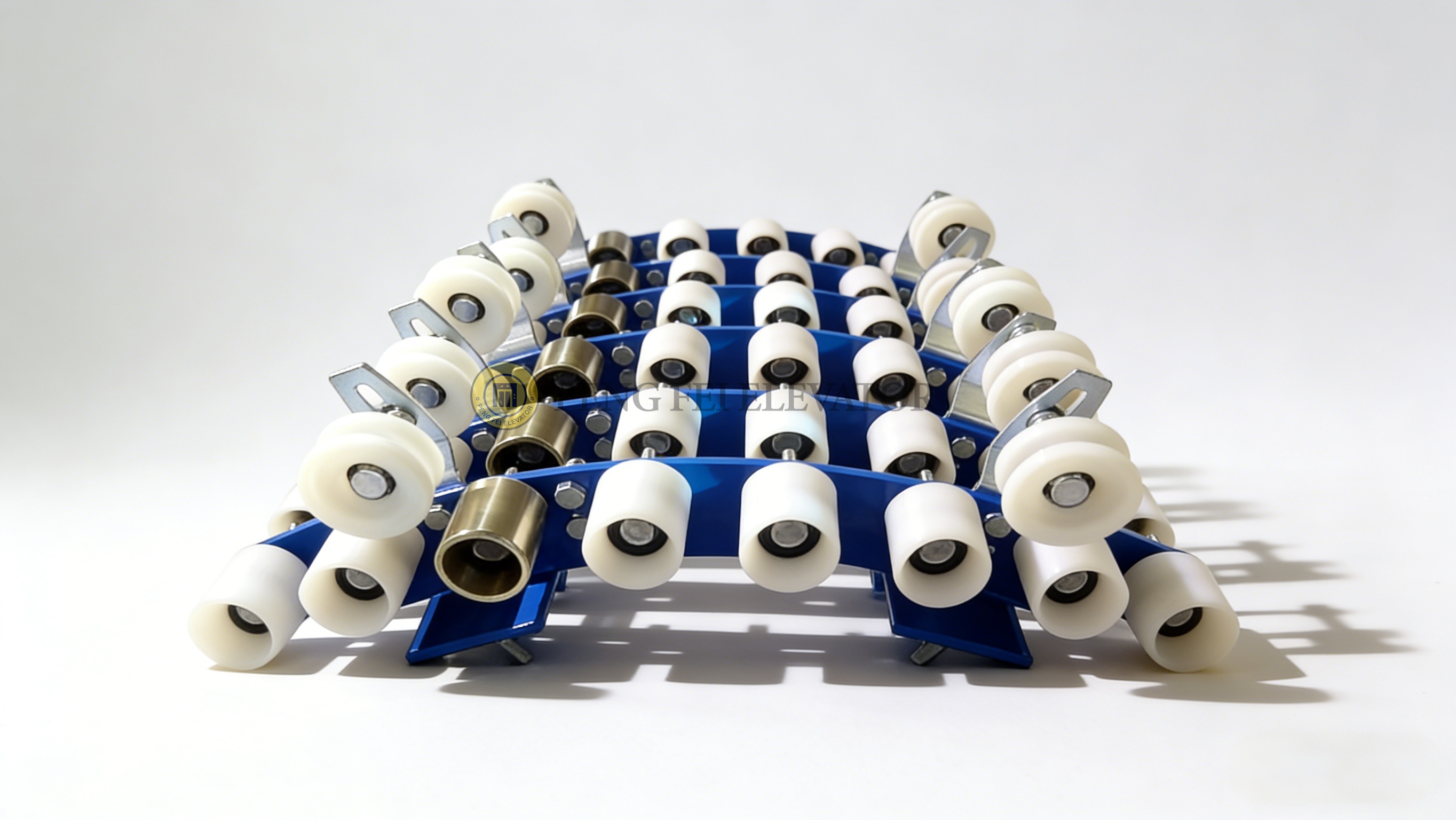
What a Worn Escalator Step Roller Can Tell You About the Entire Escalator
What a Worn Escalator Step Roller Can Tell You About the Entire Escalator
During routine escalator maintenance, replacing a worn step roller is a common task. However, experienced technicians know that a damaged roller is rarely an isolated problem.
In many cases, the roller is only the first component to show visible wear. By carefully observing its condition, maintenance personnel can often identify hidden issues elsewhere in the escalator system before they become major failures.
Instead of asking "Should this roller be replaced?", a better question is "Why did this roller wear out in the first place?"
Uneven Roller Wear Usually Indicates Alignment Problems
When one side of a step roller wears noticeably faster than the other, replacing the roller alone may not solve the issue.
Uneven wear can indicate:
·Guide track misalignment
·Incorrect step positioning
·Loose roller shafts
·Worn guide rails
If these conditions remain unchanged, the new roller may develop the same wear pattern after only a short period of operation.
For this reason, experienced maintenance teams always inspect the running path before installing replacement parts.
Flat Spots Can Reveal Operating Conditions
A healthy step roller rotates continuously while the escalator operates.
If a roller develops flat spots, technicians should consider whether the roller has stopped rotating freely.
Possible causes include:
·Seized bearings
·Dirt entering the bearing
·Lack of lubrication
·Excessive mechanical load
Flat spots often produce a rhythmic knocking sound that becomes more noticeable as passenger traffic increases.
Surface Cracks Are Not Always Caused by Age
Cracks in the roller surface are often blamed on normal aging, but operating conditions can also play an important role.
Factors such as heavy passenger loads, sudden impacts, extreme temperatures, or chemical exposure may accelerate material deterioration.
Examining the pattern of the cracks can help determine whether the issue is related to operating conditions rather than simply the service life of the roller.
Bearings Deserve as Much Attention as the Roller
Many maintenance inspections focus on the roller surface while overlooking the bearing inside.
Before replacing a step roller, check whether the bearing rotates smoothly without excessive resistance or abnormal noise.
A high-quality roller fitted with a damaged bearing cannot provide stable performance.
Whenever practical, evaluate the complete roller assembly instead of only the outer wheel.
Don't Ignore Wear on Adjacent Rollers
A single damaged roller may not be the only problem.
During inspection, compare the condition of neighboring step rollers.
If several rollers show similar wear, the escalator may have a broader mechanical issue affecting multiple steps.
Looking at the overall wear pattern often provides more useful information than examining one component in isolation.
A Practical Habit Used by Experienced Technicians
Many experienced maintenance engineers follow a simple routine after removing a worn roller.
They place the old roller beside the replacement and compare:
·Wheel diameter
·Surface wear pattern
·Bearing condition
·Rotation resistance
·Material deformation
This quick comparison often provides valuable clues about how the escalator has been operating over the past maintenance cycle.
It also helps maintenance teams identify recurring problems before they affect passenger service.
Why Choose PF Elevator Parts?
PF Elevator Parts manufactures high-quality elevator and escalator spare parts for maintenance companies, distributors, and OEM customers worldwide.
Our product range includes escalator step rollers, guide rollers, comb plates, step chains, guide shoes, traction sheaves, deflector sheaves, and many other replacement components.
With precision manufacturing, stable product quality, and OEM customization services, PF Elevator Parts supports long-term maintenance programs across a wide range of elevator and escalator systems.
Final Thoughts
A worn step roller should never be viewed as just another replacement part. Its wear pattern can provide valuable information about alignment, bearing condition, loading, and the overall health of the escalator.
For maintenance teams, treating every worn component as a source of diagnostic information leads to better repairs, fewer repeat failures, and more reliable escalator operation.
We offer various mechanical replacement parts for escalators and elevators. The products include escalator tooth plates, step frame strips, wear-resistant guide rail strips, step rollers, sprockets, driving rollers, driving friction wheels, driving shafts, gear assemblies, step chains, complete chain components, handrail belts, etc. In addition, we also provide elevator wire rope head assemblies, traction machine shock absorbers, car shock absorbers, sliding guide shoes, hollow guide rails, cast iron guide shoe shoes, traction wheels, guide wheels, buffers, etc. All wear-prone components suitable for electric escalators are compatible with mainstream elevator brands and are applicable for equipment maintenance, renovation projects, and new machine assembly. We offer OEM customization services and can handle large-scale orders as well as small-scale repair orders. Our products are of stable quality and the factory direct sales price has a significant advantage.