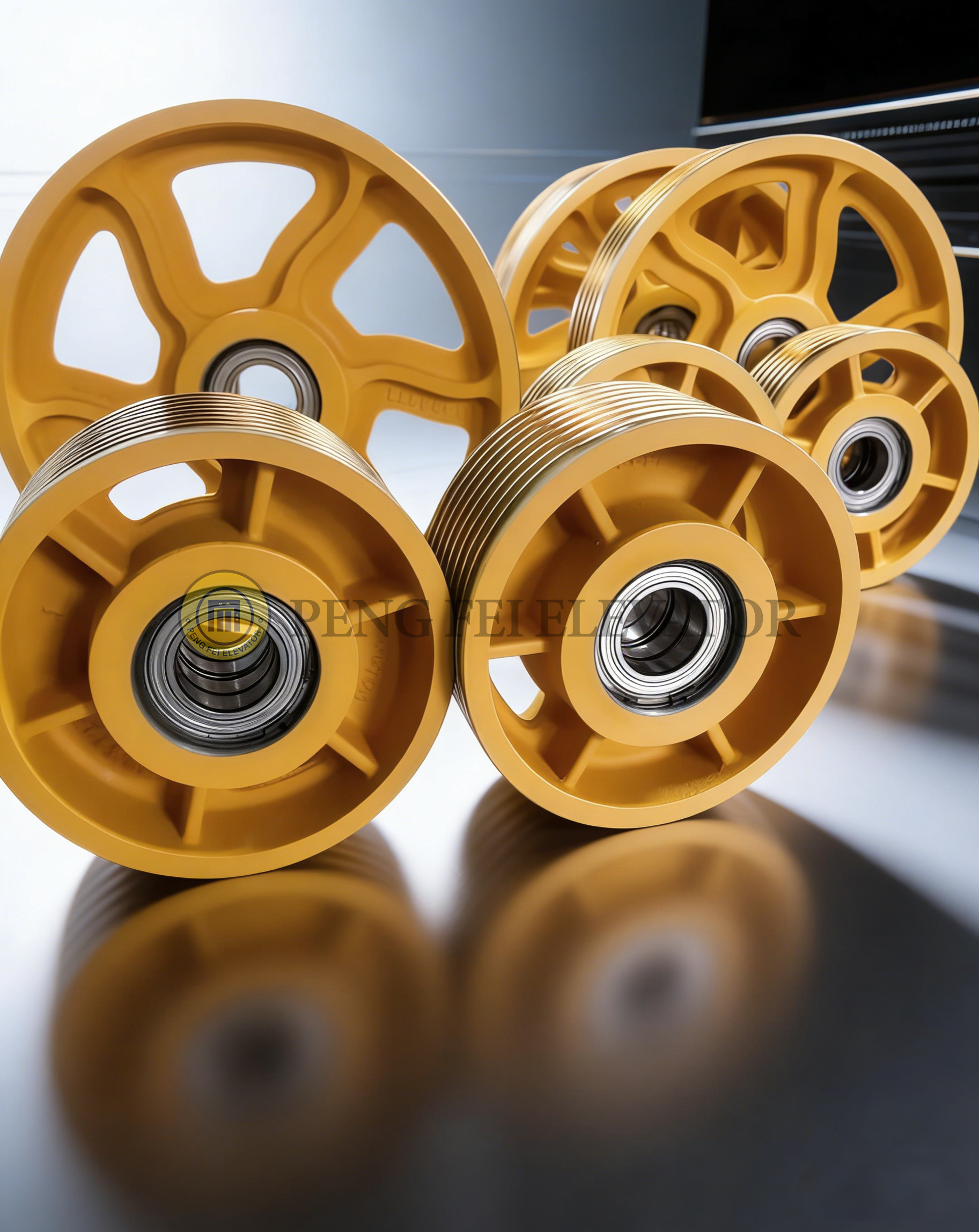
How Escalator Friction Wheel Design Can Reduce Repeat Maintenance
For escalator maintenance teams, replacing a worn spare part is usually only one step in the repair process.
The real challenge is often what happens afterward.
A replacement component may be installed correctly, yet technicians may still need to make adjustments, check alignment, monitor running conditions, or return to the same escalator later. When this happens repeatedly, the problem is not always the technician's installation work. Sometimes, it starts much earlier—with how the spare part itself was designed and manufactured.
This is particularly important for escalator friction wheels.
A friction wheel may appear to be a relatively simple component, but its material, dimensions, surface characteristics, hardness, geometry, and manufacturing consistency can all influence how it performs in an actual escalator system.
For a spare parts manufacturer, therefore, developing an escalator friction wheel should not begin with simply copying the dimensions of an existing part. It should begin with understanding what maintenance personnel need from the replacement component.
Maintenance Problems Are Often More Than “Part Wear”
When technicians replace an escalator component, their objective is rarely just to install a new part.
They want the escalator to return to stable operation with as little additional adjustment as possible.
This means a replacement friction wheel needs to be considered from several practical perspectives.
A technician may care about:
Whether the replacement dimensions are consistent from one batch to another
Whether the component fits correctly with the existing assembly
Whether the material is suitable for the operating environment
Whether the contact surface behaves consistently during operation
Whether installation requires unnecessary adjustment
Whether the replacement can provide predictable service performance
Whether the same problem is likely to return after a short period
These concerns are easy to overlook when spare parts are evaluated only by appearance.
Two friction wheels can look almost identical while having meaningful differences in material behavior, dimensional tolerance, surface condition, or manufacturing consistency.
That is why maintenance feedback is valuable to manufacturers.
Why Dimensional Consistency Matters
In escalator spare parts, dimensional accuracy is not simply a manufacturing issue. It directly affects installation and maintenance work.
A friction wheel needs to work as part of an existing mechanical system. If critical dimensions vary between batches, technicians may find that one replacement installs smoothly while another requires additional adjustment.
From a factory perspective, this creates an important development question:
Which dimensions actually matter most during field installation and operation?
Instead of measuring every dimension only for production control, manufacturers can identify the dimensions that have the greatest influence on installation, contact, alignment, and running behavior.
This allows quality control to focus on functional dimensions rather than treating every measurement equally.
For maintenance teams, the benefit is straightforward: more consistent replacement parts can make the installation process more predictable.
Material Selection Should Start With Working Conditions
Another important consideration is friction wheel material.
A material should not be selected simply because it has been commonly used in a similar component.
The actual application environment matters.
Escalators can operate under different duty cycles and environmental conditions. Passenger traffic, operating frequency, surrounding temperature, contamination, cleaning practices, and maintenance conditions can all influence component performance.
For a manufacturer, this means material development should consider the actual working conditions of the component.
The key questions include:
What type of contact does the wheel experience?
What kind of mechanical load does it encounter?
How frequently does it operate?
What environmental conditions may affect the material?
What balance is required between wear resistance and other mechanical properties?
These questions can help manufacturers move from simply producing a replacement part to developing an application-oriented spare part.
The Goal Is Not Always Maximum Hardness
One common mistake in mechanical spare-part development is assuming that a harder material will automatically provide better service.
In reality, material selection often involves balancing multiple properties.
A friction wheel must operate within the characteristics of the system in which it is installed. Excessively hard or excessively soft material may each create different performance considerations depending on the application.
The manufacturer therefore needs to look at the complete working relationship between the wheel and its mating components.
This is where field feedback becomes especially useful.
If technicians repeatedly report a particular pattern of wear, deformation, noise, vibration, or adjustment difficulty, those observations can become engineering information.
The purpose of product development is not simply to make the part “stronger.”
It is to make the part more suitable for the actual job it needs to perform.
Designing for the Technician's Installation Process
A good spare part should also consider the person installing it.
This is an area where manufacturers can often make meaningful improvements without dramatically changing the overall product.
For example, product development can examine:
Ease of positioning during installation
Dimensional consistency
Identification of the correct model
Compatibility with existing assemblies
Packaging protection during transportation
Ease of visual inspection before installation
Repeatability between replacement batches
These details may seem small, but maintenance work is often made up of many small decisions.
When a component is easier to identify, inspect, install, and adjust, the technician can spend less time dealing with uncertainty.
For a spare parts manufacturer, this creates a broader definition of product quality.
Quality is not only whether the part can be manufactured. It is also whether the part makes sense in the maintenance workflow.
What Manufacturers Can Learn From Failed Parts
A removed friction wheel should not automatically be treated as waste.
It can also be a source of information.
When manufacturers work closely with maintenance teams, worn or failed components can provide useful clues about actual operating conditions.
For example, engineers can pay attention to:
Where the wear is concentrated
Whether the wear pattern is uniform
Whether deformation is present
Whether the contact surface changes over time
Whether damage appears related to installation
Whether similar issues occur across different applications
This information can help separate different types of problems.
A component may fail because of material selection. Another may be affected by installation conditions. A third may indicate an interaction between the replacement component and the surrounding system.
Without field feedback, these situations can easily be treated as the same problem.
With field feedback, they can become different engineering cases.
From Replacement Parts to Application-Specific Development
This is an important direction for the spare parts industry.
The future of elevator and escalator spare parts is not necessarily about producing more models. It can also be about producing more suitable versions for specific applications.
For example, manufacturers may gradually develop components according to different operating environments, equipment generations, installation requirements, or performance priorities.
This approach is particularly valuable for maintenance companies that work with different escalator systems.
Instead of asking only:
“Do you have this part?”
The more useful question becomes:
“Which version of this part is most appropriate for this application?”
That shift changes how a factory approaches product development.
How PF Elevator Parts Approaches Spare Part Development
At PF Elevator Parts, the manufacturer perspective is closely connected with actual maintenance requirements.
For components such as escalator friction wheels and other elevator and escalator spare parts, product development should consider more than basic dimensions.
Material selection, manufacturing consistency, application conditions, installation requirements, and feedback from the maintenance side can all contribute to better product development decisions.
As a factory, PF Elevator Parts can also support customized spare-part development based on drawings, samples, dimensions, or specific application requirements.
This is particularly useful when maintenance companies encounter older equipment, replacement parts with inconsistent availability, or components that require a more suitable replacement solution.
The objective is not simply to produce another replacement component.
It is to understand why the maintenance team needs the component and what would make the replacement process easier and more predictable.
The Next Step: Designing Spare Parts Around Real Maintenance Data
For manufacturers, the most valuable product-development information does not always come from a drawing.
Sometimes it comes from the maintenance site.
Repeated adjustments, unusual wear patterns, installation difficulties, premature replacement, and inconsistent fitting can all reveal opportunities for better product design.
As the elevator and escalator spare parts industry develops, manufacturers can increasingly use this information to improve:
Material selection
Product geometry
Dimensional control
Batch consistency
Application-specific designs
Installation convenience
Long-term product evaluation
This creates a continuous cycle:
Maintenance problem → field feedback → engineering analysis → product improvement → better replacement experience.
That cycle is more meaningful than simply replacing one worn part with another.
What This Means for Maintenance Teams
For maintenance personnel, a replacement spare part should be evaluated not only by price or appearance.
A better evaluation considers whether the part is:
Dimensionally consistent
Appropriate for the application
Manufactured with suitable materials
Easy to install
Predictable between batches
Supported by a manufacturer that understands field requirements
An escalator friction wheel may be a relatively small component, but its development can reflect a much larger principle in the spare parts industry:
The best replacement parts are developed by understanding how maintenance work is actually performed.
For manufacturers, listening to technicians is not simply customer service.
It is part of engineering.
And for maintenance teams, choosing a supplier that understands this relationship can make spare-part replacement more predictable, practical, and efficient.
We offer various mechanical replacement parts for escalators and elevators. The products include escalator tooth plates, step frame strips, wear-resistant guide rail strips, step rollers, sprockets, driving rollers, driving friction wheels, driving shafts, gear assemblies, step chains, complete chain components, handrail belts, etc. In addition, we also provide elevator wire rope head assemblies, traction machine shock absorbers, car shock absorbers, sliding guide shoes, hollow guide rails, cast iron guide shoe shoes, traction wheels, guide wheels, buffers, etc. All wear-prone components suitable for electric escalators are compatible with mainstream elevator brands and are applicable for equipment maintenance, renovation projects, and new machine assembly. We offer OEM customization services and can handle large-scale orders as well as small-scale repair orders. Our products are of stable quality and the factory direct sales price has a significant advantage.