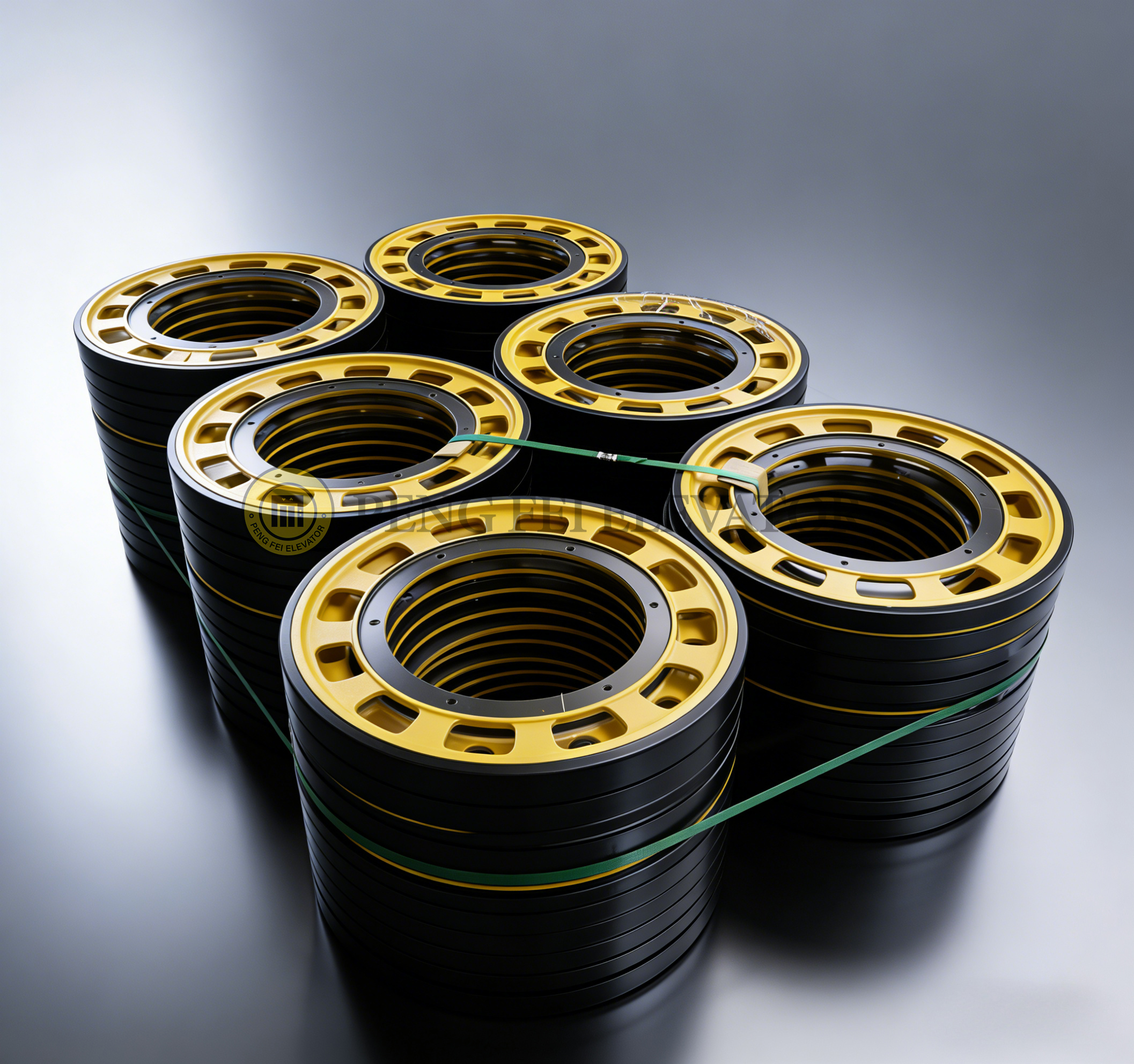
Elevator Traction Sheave Replacement: Why Groove Matching Matters
When an elevator traction sheave needs to be replaced, the first concern is usually whether the replacement can physically fit the existing machine.
That is certainly important.
But for maintenance teams, there is another question that deserves equal attention:
Does the rope groove of the replacement traction sheave properly match the application?
The traction sheave is an important part of the elevator drive system. Its interaction with the hoist ropes is directly related to the mechanical working conditions of the system.
For this reason, replacing an Elevator Traction Sheave should not be treated as a simple matter of matching the outside diameter or mounting dimensions.
The details of the groove design, dimensions, material, and application all deserve consideration.
- Start With the Condition of the Existing Traction Sheave
Before ordering a replacement, maintenance technicians can learn a great deal from the existing traction sheave.
Instead of removing the old component and immediately treating it as a discarded part, it can be useful to inspect its condition carefully.
Particular attention can be given to:
Rope groove condition
Visible wear
Groove surface condition
Uneven wear between grooves
Signs of abnormal contact
Changes in groove geometry
General condition of the sheave
The condition of the existing component can help technicians understand what has happened during operation.
A traction sheave that has been operating for a long period may show normal wear. However, unusual or uneven wear deserves further investigation before the replacement is selected.
This is an important maintenance principle:
The old part can provide information about the new part you need.
- Why Rope Groove Matching Deserves Attention
The rope grooves are not simply decorative features on the surface of a sheave.
They form the contact area between the traction sheave and the hoist ropes.
For this reason, groove geometry is one of the details that should be considered when sourcing a replacement.
Maintenance and purchasing teams may need to confirm information such as:
Number of grooves
Groove dimensions
Groove profile
Sheave diameter
Required mounting dimensions
Compatible rope information
Equipment application
The exact requirements depend on the elevator system.
This is why copying only the general appearance of an existing Elevator Sheave may not be sufficient.
A replacement should be developed around the actual application.
- Similar-Looking Sheaves May Not Be Interchangeable
One of the challenges with elevator spare parts is that components from different applications can look remarkably similar.
Two traction sheaves may have similar overall dimensions while having differences in important details.
For example, differences may exist in:
Number of rope grooves
Groove profile
Groove dimensions
Shaft or mounting configuration
Overall dimensions
Material requirements
These details can affect whether a component is appropriate for a particular elevator application.
This is why maintenance companies should provide as much technical information as possible when requesting a replacement.
A product photograph is useful for identification, but it may not provide enough information for accurate manufacturing.
A drawing, sample, dimensional data, or existing component can provide a much stronger basis for replacement development.
- The Right Replacement Starts With the Right Information
For maintenance teams, one of the easiest ways to reduce uncertainty during spare-part sourcing is to prepare detailed information before placing an order.
Useful information may include:
Equipment information
The elevator model or machine application can help establish the context.
Existing component dimensions
Measurements of the original traction sheave can help confirm the physical requirements.
Rope information
The rope configuration and relevant dimensions are important when considering the groove design.
Mounting information
The shaft, keyway, bearing arrangement, or other connection details may need to be confirmed according to the specific application.
Photographs or samples
Images from several angles or an actual sample can help the manufacturer understand details that may not appear in a simple measurement list.
This approach benefits both sides.
The maintenance team receives a more accurately matched replacement.
The manufacturer receives better information for production.
- Material Selection Is Part of the Replacement Decision
The material of an elevator traction sheave is another factor that should be considered according to the application.
A manufacturer should not select material simply because it was used on another sheave.
The working environment, mechanical requirements, design, and application all need to be considered together.
From a factory perspective, this means product development involves more than machining the required shape.
It involves understanding what the component needs to do after it leaves the factory.
For maintenance teams, this is particularly relevant when replacing an older or hard-to-source component.
If the original product information is incomplete, the manufacturer may need to evaluate the available sample, measurements, application information, and operating requirements before determining an appropriate production solution.
- Installation Is Where Compatibility Becomes Practical
A replacement traction sheave may meet the basic dimensional requirements, but the installation process still provides an important practical check.
Before installation, technicians can confirm the relevant dimensions and mounting details against the existing equipment.
After installation, the condition of the system should be checked according to the applicable maintenance procedure.
Attention can be given to:
Correct installation position
Mounting condition
Rope and groove relationship
Alignment
Running condition
Unusual noise or vibration
Any abnormal behavior requiring further investigation
The objective is not simply to confirm that the component has been installed.
The objective is to confirm that the replacement is working appropriately within the complete elevator system.
This is why a spare part should always be viewed as part of an assembly rather than as an isolated product.
- What a Manufacturer Should Do When the Original Part Is Difficult to Source
Older elevator equipment can create a particular challenge for maintenance companies.
The original traction sheave may no longer be readily available through the original supply channel.
In this situation, maintenance teams may need a manufacturer capable of working from available technical information.
This is where customized spare-part manufacturing can become valuable.
A manufacturer may be able to work from:
Existing drawings
Physical samples
Detailed measurements
Product photographs
Application information
Customer-specific requirements
The development process can then focus on reproducing the required functional and dimensional characteristics rather than simply searching for a visually similar product.
For a spare-parts manufacturer, this requires close communication with the maintenance side.
The more accurate the original information, the more effectively the replacement can be developed.
- Turning Maintenance Requirements Into Better Spare-Part Development
The most useful product-development information often comes from actual maintenance work.
If technicians repeatedly report problems such as difficult identification, unclear dimensions, inconsistent replacement information, or special requirements for older equipment, these experiences can help manufacturers improve their products and services.
For Elevator Spare Parts, this can lead to improvements in:
Dimensional documentation
Product identification
Manufacturing consistency
Material selection
Customized production
Sample-based development
Quality inspection
Packaging and transportation protection
The factory therefore has an important role beyond simply producing the component.
It can help turn maintenance requirements into a more complete replacement solution.
At PF Elevator Parts, elevator and escalator spare parts can be developed around practical customer requirements, including drawings, samples, dimensions, and application information.
This is particularly useful when a standard replacement is difficult to identify or when an existing component needs to be reproduced according to specific equipment requirements.
What Maintenance Teams Should Remember
When replacing an elevator traction sheave, the most important question is not simply:
“Will this sheave fit?”
A better set of questions is:
Does the groove configuration match the application?
Are the critical dimensions confirmed?
Is the mounting arrangement correct?
Is the material suitable for the intended application?
Can the manufacturer provide consistent production?
Is enough information available to develop an accurate replacement?
Taking these questions into consideration can make spare-part sourcing more systematic.
It can also reduce the risk of choosing a replacement based only on appearance.
For maintenance teams, a traction sheave is not just another replacement component.
It is a component that needs to be considered together with the ropes, mounting arrangement, drive system, and actual elevator application.
For manufacturers, this provides an equally important lesson:
Better spare parts begin with better understanding of the equipment they are designed to serve.
Whether the requirement involves an elevator traction sheave, an escalator component, or another specialized Elevator & Escalator Spare Part, accurate technical information and communication between the maintenance team and manufacturer remain essential.
The goal is not simply to produce a part that looks like the original.
The goal is to develop a replacement that makes sense for the equipment, the application, and the people responsible for maintaining it.
We offer various mechanical replacement parts for escalators and elevators. The products include escalator tooth plates, step frame strips, wear-resistant guide rail strips, step rollers, sprockets, driving rollers, driving friction wheels, driving shafts, gear assemblies, step chains, complete chain components, handrail belts, etc. In addition, we also provide elevator wire rope head assemblies, traction machine shock absorbers, car shock absorbers, sliding guide shoes, hollow guide rails, cast iron guide shoe shoes, traction wheels, guide wheels, buffers, etc. All wear-prone components suitable for electric escalators are compatible with mainstream elevator brands and are applicable for equipment maintenance, renovation projects, and new machine assembly. We offer OEM customization services and can handle large-scale orders as well as small-scale repair orders. Our products are of stable quality and the factory direct sales price has a significant advantage.