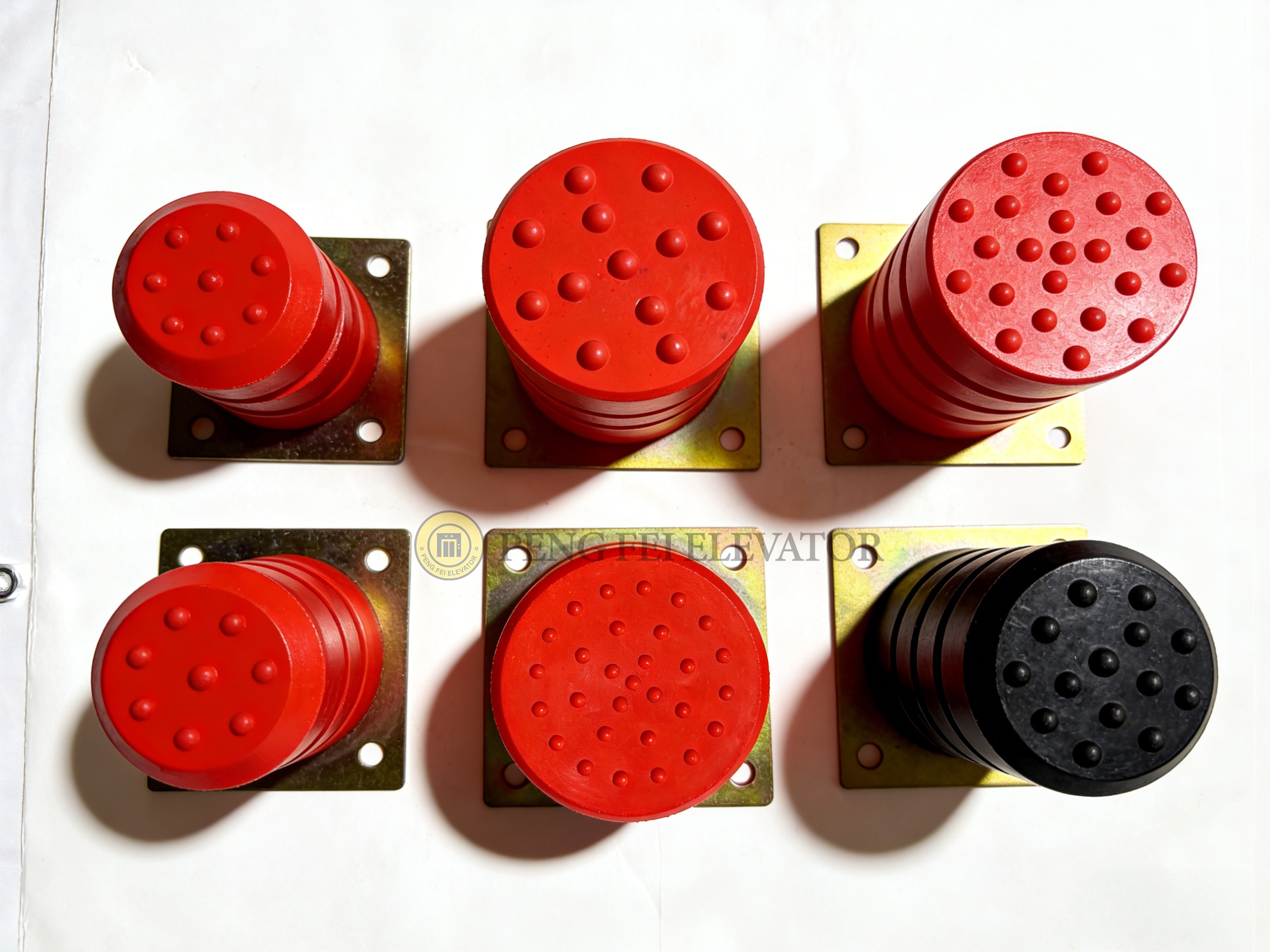
How to Choose the Right Elevator Anti-Vibration Pad for Maintenance and Replacement
Unwanted vibration in an elevator is not always caused by a major mechanical component.
Sometimes, a small rubber component installed between two parts of the system can influence how vibration and movement are transferred through the structure. This is where an elevator anti-vibration pad can become an important maintenance component.
When an existing pad becomes compressed, damaged, hardened, or otherwise unable to perform as required, replacing it may appear to be a simple task. However, selecting a suitable replacement involves more than matching the shape of the old rubber pad.
For maintenance technicians and elevator spare parts buyers, installation position, dimensions, material characteristics, loading conditions, and mounting requirements should all be considered before ordering.
For manufacturers, these same details are important when developing replacement rubber components for different elevator applications.
Start With Where the Pad Is Installed
The first question when replacing an anti-vibration pad should not be "What size is it?"
It should be:
Where is the pad installed, and what is its function in that position?
An elevator contains different components and assemblies, and a rubber pad may be used in different locations depending on the equipment design.
Its function can include helping isolate vibration, reducing direct transmission of movement between components, providing a cushioning interface, or accommodating small amounts of movement between connected parts.
Because the installation position determines the working conditions, two rubber pads that look similar may not necessarily be suitable substitutes for each other.
Before ordering a replacement, technicians should identify the exact installation location and understand what the original component is intended to do.
This simple step can prevent a common mistake: choosing a replacement based mainly on appearance.
Inspect the Existing Pad Before Removing It
An old rubber pad can provide useful information about the operating environment.
Before removing it, technicians can inspect its condition and record any visible changes.
Typical observations may include:
Compression or permanent deformation
Cracks on the rubber surface
Hardening or changes in flexibility
Surface deterioration
Uneven compression
Edge damage
Changes in thickness
Marks caused by contact with surrounding components
The wear pattern can sometimes provide clues about how the component has been loaded.
For example, uneven deformation may suggest that the load is not distributed uniformly. Surface damage may indicate contact with another component or an installation issue.
This does not automatically mean that the anti-vibration pad is the root cause of the problem.
The surrounding structure should also be inspected.
The objective is to understand the condition of the complete installation rather than treating the rubber pad as an isolated component.
Dimensions Matter, but They Are Not the Whole Story
For many replacement parts, dimensional compatibility is the first requirement.
The same applies to elevator rubber pads.
Important dimensions may include:
Overall length and width
Thickness
Central hole diameter
Hole position
Outer profile
Contact area
Mounting dimensions
However, dimensional matching alone may not provide enough information.
Rubber components also have material characteristics that influence how they behave under compression, vibration, temperature changes, and repeated loading.
Therefore, a replacement should be considered from two sides:
Geometrical compatibility — Can the part be installed correctly?
Material suitability — Is the component appropriate for its intended operating condition?
This distinction is especially important when replacing an original component that has been used for a long period.
A replacement that fits the mounting position but has unsuitable material characteristics may not provide the same practical result.
Material Selection Should Follow the Application
Rubber is not simply "rubber."
Different rubber materials and formulations can have different characteristics, including hardness, elasticity, resistance to environmental conditions, and behavior under repeated compression.
For an elevator anti-vibration pad, material selection should therefore be connected to the application.
Factors worth considering can include:
Expected loading
Frequency of movement or vibration
Installation environment
Temperature conditions
Exposure to oil or other substances
Required flexibility
Compression behavior
Expected replacement conditions
The correct material depends on the actual application and design requirements.
For a spare parts manufacturer, this means that material selection should begin with understanding the customer's operating conditions rather than choosing a material based only on the appearance of the original pad.
When customers provide information about the equipment and installation environment, manufacturers can make more informed decisions about the replacement component.
Installation Can Affect the Result
Even a properly selected anti-vibration pad may not perform as expected if it is installed incorrectly.
During replacement, technicians should check whether the contact surfaces are clean and properly positioned.
The pad should sit correctly within its intended location without unnecessary twisting, folding, or uneven loading.
The surrounding components should also be checked for:
Misalignment
Damaged mounting surfaces
Loose fasteners
Excessive contact pressure
Foreign material
Unexpected gaps
Uneven loading
This is particularly important when the old pad has developed an unusual deformation pattern.
Installing a new pad without checking the reason for the previous deformation may simply reproduce the same problem.
In practical maintenance, installation is therefore part of the replacement process—not a separate step after selecting the part.
When Vibration Remains After Replacement
One of the most important points for maintenance teams is that an anti-vibration pad should not automatically be treated as the solution to every elevator vibration problem.
If vibration continues after replacement, technicians may need to investigate other possible sources.
Depending on the elevator design, attention may need to be given to:
Rotating components
Mechanical alignment
Mounting conditions
Fasteners
Guide-related components
Machine or structural vibration
Other rubber isolation components
Contact between components
This broader inspection is useful because vibration can travel through multiple components.
A damaged rubber pad may make an existing vibration more noticeable, but replacing the pad does not necessarily remove the original source.
This is why experienced maintenance work often follows the vibration path rather than focusing on a single component.
Why Replacement Consistency Matters
For an elevator service company purchasing one replacement pad, dimensional accuracy is important.
For a distributor or maintenance company purchasing the same type of component repeatedly, consistency becomes even more important.
Repeated orders should ideally maintain stable:
Dimensions
Hole positions
Thickness
Material characteristics
Surface condition
Overall manufacturing quality
If replacement parts vary significantly from one batch to another, technicians may need to spend additional time checking whether each component is suitable before installation.
From a manufacturer's perspective, this makes production control an important part of spare parts development.
The goal is not simply to manufacture a rubber pad that looks like the sample. The goal is to establish a repeatable manufacturing process for the required specification.
What Information Should Be Provided to the Manufacturer?
When an elevator anti-vibration pad is difficult to identify, providing more information can make the replacement process much easier.
Useful information may include:
Photos of the original pad
Overall dimensions
Thickness
Hole diameter and position
Installation location
Photos of the mounting position
Equipment information, if available
Original drawings or part numbers
Material requirements, if known
Quantity required
A physical sample can also be useful when the original specification is difficult to determine from measurements alone.
This type of information allows the manufacturer to understand the replacement requirement more accurately.
For customized elevator spare parts, the communication process is often just as important as the manufacturing process.
How Manufacturers Can Improve Anti-Vibration Pad Development
A spare parts manufacturer can learn a great deal from actual maintenance feedback.
If technicians repeatedly report that a pad deforms in a particular installation, that information deserves attention.
If customers frequently request a specific dimension or mounting configuration, it may indicate a recurring replacement requirement.
If different operating environments produce different wear patterns, manufacturers can use this information to better understand how the component is being used.
This creates a practical feedback cycle:
Field problem → Inspection → Customer feedback → Specification review → Manufacturing → Installation → Further feedback
The purpose is not to change every product whenever a problem appears.
Instead, manufacturers can distinguish between issues caused by the component itself and those related to installation, loading, surrounding components, or operating conditions.
This helps spare parts development remain based on actual maintenance requirements.
A Practical Replacement Checklist
Before ordering an elevator anti-vibration pad, maintenance teams can quickly confirm the following:
Installation
Where is the pad installed?
What components does it separate or support?
Is the mounting surface in good condition?
Dimensions
What are the length, width, and thickness?
Is there a central hole?
What are the hole diameter and position?
Condition
Is the original pad cracked?
Has it become permanently compressed?
Is the deformation even or uneven?
Material
Is the original material known?
What environmental conditions does the pad experience?
Are there specific flexibility or hardness requirements?
Replacement
Is a drawing available?
Is a physical sample available?
Does the replacement need to be customized?
These checks can help reduce uncertainty before the replacement is manufactured or ordered.
Small Component, Practical Maintenance Value
An elevator anti-vibration pad may not be one of the largest components in an elevator system, but its installation position and material characteristics can make it relevant to vibration isolation and component interaction.
The key is not to treat the pad as a generic piece of rubber.
A better replacement process considers:
where it is installed, how it is loaded, what condition the original part is in, what dimensions are required, and what material is appropriate for the application.
For elevator maintenance teams, this approach can make replacement decisions more systematic.
For spare parts manufacturers, it provides a clearer direction for product development: understand the installation environment, listen to maintenance feedback, control the important dimensions, and develop replacement components around real field requirements.
That is how a small spare part can become a more practical part of an elevator maintenance solution.
We offer various mechanical replacement parts for escalators and elevators. The products include escalator tooth plates, step frame strips, wear-resistant guide rail strips, step rollers, sprockets, driving rollers, driving friction wheels, driving shafts, gear assemblies, step chains, complete chain components, handrail belts, etc. In addition, we also provide elevator wire rope head assemblies, traction machine shock absorbers, car shock absorbers, sliding guide shoes, hollow guide rails, cast iron guide shoe shoes, traction wheels, guide wheels, buffers, etc. All wear-prone components suitable for electric escalators are compatible with mainstream elevator brands and are applicable for equipment maintenance, renovation projects, and new machine assembly. We offer OEM customization services and can handle large-scale orders as well as small-scale repair orders. Our products are of stable quality and the factory direct sales price has a significant advantage.